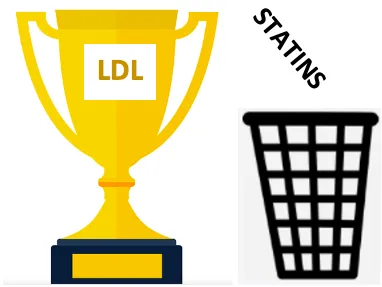
Is High LDL (So Called “Bad” Cholesterol) the Key to a Long Life?
Yes, you read that right. When it comes to cholesterol it would seem that size matters and statins may be counter-productive.
Should we heed the findings of studies showing that cholesterol and saturated are not the drivers of heart disease or risk succumbing to recommendations to take statins that could not only shorten life but make us miss the true problems?
After 70 Years Discredited But Not Dead
The lipid (fat) hypothesis has sat comfortably and virtually unchallenged until recently. Though now being seriously challenged, many people continue to believe that saturated fat and cholesterol, from our diet, leads to clogged arteries, leading to heart disease, strokes and heart attacks. Heart disease is still the number one cause of death in the West.
Could So Much Pain, Suffering and Grief Have Been Avoided …
This hypothesis was presented as the reason for President Eisenhower’s heart attack in 1955 and from then on gained enormous traction around the world. Yet it is being proposed that we have been misdirected all this time meaning that the advice, treatments and money spent in diagnostics, surgery, medication, education and rehabilitation have all been a substantial waste of time. Really?
They Will Be Hard to Ignore
Dr Paul Mason (love him or loathe him … but you shouldn’t ignore him) is eloquently presenting serious challenge to the lipid hypothesis. Together with Dr Ben Bikman and Dr David Diamond they have published a paper entitled “Statin Therapy is not Warranted for a Person with high LDL Cholesterol on a low carbohydrate diet” (1)
As Mason puts it, we have been told that “eating saturated fat causes our LDL level to rise” (so called bad cholesterol) “which then blocks our arteries”. He challenges this statement and asks, where is the evidence that high LDL will kill you and presents, instead evidence that LDL cholesterol is a key for longevity?
Just Because You See Fire Engines Where There Are Fires Doesn’t Mean They Cause Them
The analogy used by some to explain the supposedly false accusations directed at LDL causing heart disease, is that in the same way that LDL cholesterol can be found in damaged arteries, so too can fire engines be found where fires are taking place. Yet one does not implicate the other. Just because two things exist at the same time does not mean that one causes the other. Correlation does not equal causation.
But LDL cholesterol is found in arterial plaque – so does it promote cardiovascular disease?
A Study of 68,000 Showed That Those with Highest LDL Level Lived Longest
The first paper Dr Mason presents, to explore this question, is from BMJ Open: “Lack of association or an inverse association between LDL cholesterol and mortality in the elderly: A systematic review.” (2) A 2016 BMJ Open review of 19 cohorts (68,000 people over 60) found that higher LDL was not linked to higher death rates, and in most cohorts it was linked to lower ones. The review is debated.
Dietary Cholesterol Does Not Raise Cholesterol
Next he challenges the long held idea that high intake of dietary cholesterol increases levels of cholesterol in the body with a paper called “35 Eggs Per Day in the Treatment of Severe Burns” (3) Patients were fed this way for a month and their cholesterol levels remained normal.
What about the long-held idea that high intake of saturated fat raises LDL?
Here again another paper is presented published in the British Medical Journal:
“Randomised Trial of Coconut Oil, Olive Oil or Butter on Blood Lipids (fats) and Other Cardiovascular Risk Factors in Healthy Men and Women”(4)Here, individuals were given either 50g of coconut oil, olive oil or butter daily for 4 weeks. The study did show a significant rise in LDL in the group consuming butter but coconut oil did not raise LDL, unlike butter. This is noteworthy because coconut oil is 94% saturated fat whereas butter merely contains 66% saturated fat.
Hence indicating that it is not the saturated fat content that raises the LDL.
So If We Discard Dietary Cholesterol and Saturated Fat as Culprits of Heart Disease, Where Else Should We Look?
To continue our search for the real cause of heart disease we need to clearly lay out some important features:
LDL stands for low density lipoprotein.
Lipoprotein is a particle that transports fats, cholesterol and antioxidants (eg Vitamin E) around the body.
Lipoprotein is formed in the liver as very low density lipoprotein (VLDL). For visual purposes a light and floaty balloon.
As the VLDL (very low density lipoprotein) off loads its cargo of fat energy and antioxidants to cells around the body it becomes smaller and becomes IDL (intermediate-density lipoprotein).
As the lipoprotein proceeds delivering its cargo it eventually becomes even smaller in size and called LDL (low density lipoprotein).
So to recap LDL starts out as VLDL (formed in the liver) but as cargo is off loaded it deflates becoming smaller in size. VLDL, IDL and LDL are all the same particle at different stages of a journey.
LDL is then taken back up by the liver for recycling.
The lipoprotein molecule at all its various stages contains the same identifying protein in its membrane, called ApoB100.
ApoB100 acts like an ID card to allow the lipoproteins to be recognised by receptors on the liver and cells throughout the body, allowing them entry, to deliver the cargo. If ApoB100 is damaged, the ID card fails and the Lipoprotein is not allowed to deliver its cargo.
Not being allowed to enter cells or return to the liver means that they are left to accumulate outside, floating around in the blood, with nowhere to go.
Can This Accumulation of Damaged LDL, That Cannot Rehouse Itself, Be a Problem?
Yes it can. The more LDL is damaged the more it continues to shrink in size, in a homeless state. It is known as “increased small LDL particle count” and it can be tested for… but never is, due to cost. Yet particle count of this small damaged LDL is a far superior predictor of cardiovascular disease that the standard cholesterol test that we are all familiar with.
It Is damaged LDL that becomes small LDL particles, forced to accumulate in the blood stream that should concern us.
More Studies
A 2018 study (5) that followed 28,000 women for 15 years showed that while standard testing for LDL cholesterol did not predict peripheral artery disease at all, testing for high “particle count” did predict it. Specifically, it showed that those with higher “small particle count” had a two and half times greater risk of peripheral artery disease.
A 2014 study (6) with more than 11,000 people again revealed the presence of small LDL particles (even when low in number) drove heart disease. Conversely healthy individuals had normal sized, undamaged LDL cholesterol and remained healthy even with high levels.
In 2020 a study(7) from Japan looked at 3,080 people over the age of 40, without prior history of heart disease who were followed for 8 years. Their findings suggested that levels of small LDL particles in the blood indicated a 5 times greater chance of future development of heart disease than normal, undamaged LDL cholesterol.
So Its True …. Size Matters
Undamaged LDL cholesterol will remain a buoyant normal size with functioning cell and liver receptors. Damaged LDL, however, becomes increasingly small in size and loses its ability to enter cells or return to the liver for recycling. Thus accumulating in the blood stream.
The Bad News and the Good News
The bad news is that the test to assess particle size is very expensive. The good news is that testing our Triglyceride levels is a strong indicator of the presence of small damaged LDL. This test is a common blood test, available to all.
Our “Good” HDL Cholesterol Offers Protection
In addition, the rate of increase in small dense LDL is much greater when levels of “good” HDL cholesterol are low. We are used to identifying LDL as bad cholesterol and HDL as good cholesterol, when instead we should be entering the mindset that both are fundamental to life and when undamaged, both are even more life enhancing at high levels.
Even More Accurate a Measurement/Predictor of Heart Disease ….
… Is the Ratio Triglyceride/HDL. Dr Mason believes that the published data is clear and these parameters indicate the difference between a state where the body’s arteries are being clogged or are not being clogged. Atherogenic or not atherogenic.
His test result ranges, for health are:
HDL Greater than or Equal to 1.3 mmol/L (52mg/dL)
Triglycerides Less than or Equal to 0.8mmol/L (70mg/dL)
Triglyceride:HDL Ratio Less than or Equal to 0.9 (using mmol/L), or 2.0 (using mg/dL)
Ask your doctor for this measurement next time you have a blood test.
So What Can Raise Levels of Small LDL Particles?
The things that oxidise (damage) LDL
Sugars and carbohydrates
Seed/ vegetable oils
Excess alcohol intake
Excess dairy consumption in some individuals, particularly women, may lead to problems but is obviously put in the shade when compared to the consumption of junk food.
A deficiency in Vitamin B12
Inflammation
Under active thyroid
Kidney disease
Diabetes
Numerous drugs including beta blockers and corticosteroids
In Summary
If the body is allowed to function properly LDL cholesterol is an efficient distributor of fat fuel, loading and unloading fat energy and antioxidants and then returning to the liver for recycling, where it can start its journey all over again.
Yet if we damage it through bad dietary choices like excess carbohydrates and other poor lifestyle choices, we block its journey through the body allowing damaged versions of itself to accumulate in the bloodstream leading to heart disease.
Dealing with insulin resistance in your body and fuelling your body on ketones from fat, more frequently than glucose from carbohydrates, will not only prevent, but help to reverse, this negative build up that can lead to heart disease and stroke.
Marina Young, Hampshire, England
References
“Statin Therapy is not Warranted for a Person with high LDL Cholesterol on a low carbohydrate diet” https://journals.lww.com/co-endocrinology/Fulltext/2022/10000
“Lack of association or an inverse association between LDL cholesterol and mortality in the elderly: A systematic review.”
https://bmjopen.bmj.com/content/6/6/e010401
35 Eggs Per Day in the Treatment of Severe Burns
https://www.jprasurg.com/article/0007-1226(75)90127-7/pdf
“Randomised Trial of Coconut Oil, Olive Oil or Butter on Blood Lipids and Other Cardiovascular Risk Factors in Healthy Men and Women”
https://bmjopen.bmj.com/content/8/3/e020167
Lipoprotein Particle Profiles, Standard Lipids and Peripheral Artery Disease Incidence – Prospective Data from the Women’s Health Study
https://pubmed.ncbi.nlm.nih.gov/30021845/
Small Dense Low-Density Lipoprotein-Cholesterol Concentrations Predict Risk for Coronary Heart Disease https://www.ahajournals.org/doi/10.1161/atvbaha.114.303284
Small Dense Low-Density Lipoprotein Cholesterol and the Risk of Coronary Heart Disease in a Japanese Community https://pubmed.ncbi.nlm.nih.gov/31708527/