So What Is the Cause of Heart Disease If We Can’t Blame Cholesterol & Saturated Fat?
What We All Need to Know About Blood Clotting, the Glycocalyx and Nitric Oxide
Blood clotting is a hot topic. Not only is it replacing the theory that LDL cholesterol and saturated fat are the causes of heart disease, but many are becoming aware that there is a strong possibility that some Covid vaccines have been linked to rare clotting problems.
The Magnificent But Largely Unknown Glycocalyx
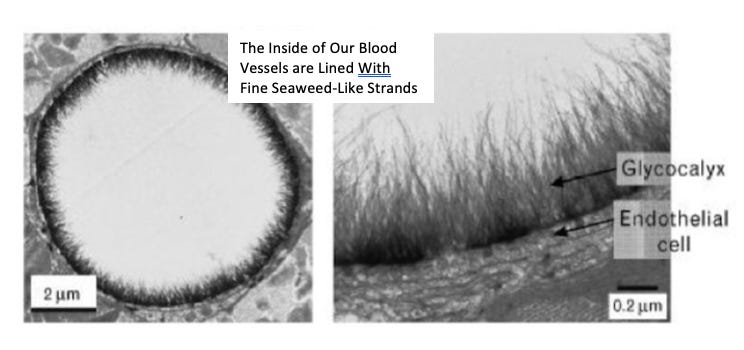
The glycocalyx is a feature in our body that is absolutely magnificent, but the majority of doctors haven’t heard of it. We all need to know what it is and how to protect it.
It looks like fine, fluffy seaweed when seen under the microscope. It lines our arteries and it is the same substance that makes the skin of fish very, very slippery. In the human body it facilitates the smooth transit of blood through our blood vessels, it is sometimes referred to as the super Teflon of the natural world. It protects us against infection and it houses enzymes and chemicals in its strands. One of these molecules is a very powerful anti-blood clotting chemical known as Nitric Oxide.
Our Body Does the Equivalent of Walking a High Wire Every Day
Our body plays a highly complex and delicate balancing act in keeping us from bleeding to death, should we cut ourselves, by enabling clot formation. It equally works hard at preventing over clotting that can block our blood flow and have equally tragic consequences.
The Life Cycle of a Blood Clot in the Simplest Terms (It is far more complex and clever)
A tear or insult to blood vessel walls must be sealed to avoid bleeds by the formation of a blood clot. Platelets in our blood stream trigger the clotting cascade that involve fibrin and red blood cells.
When a clot is stabilised, it is “shaved” back and EPCs (endothelial progenitor cells) proceed to cover the blood clot and absorb it back into the vessel wall.
When we are young the repair process is rapid and efficient but as we age the repair process starts to slow down.
As we age we must focus on preventing injury to our arteries as our repair mechanisms become less effective.
Dr Malcolm Kendrick’s latest of a series of fascinating books is cleverly called
“The Clot Thickens: The enduring mystery of heart disease” published in 2021 by Columbus. In this book he states that “it is important to realise that the very existence of the glycocalyx was completely unknown when people were coming up with the cholesterol hypothesis” (for the cause of heart disease). A hypothesis that is over simplistic and completely ignores the sophistication and utter complexity of our body. The glycocalyx and nitric oxide are just two members of a large and complex cast of characters that perform a powerful balancing act in our cardiovascular system and we must learn how to protect this cast of characters and lessen their load.
Although the glycocalyx looks very delicate, if damaged, it has the ability to repair itself within seconds. It does this by absorbing nutrients from its surrounding plasma. It is important to know what these nutrients are, so that we can continue to provide this marvellous mechanism with what it needs to carry out its important role. (See below).
The Magic of Nitric Oxide
Its role in our blood vessels was discovered in the late 1980s; it is a gas, one atom of oxygen and one atom of nitrogen (NO).
Notably it helps prevent anything sticking to the glycocalyx.
It has the capacity to relax and dilate the arteries, thus lowering blood pressure, but it is very transitory and needs to be continuously produced.
It is the most powerful anti blood clotting agent known to man.
It is so important that anything that lowers Nitric Oxide will raise the chances of heart disease.
Erectile dysfunction is generally associated with lower production of Nitric Oxide and is why Viagra resolves this dysfunction by boosting the effect of nitric oxide.
(Viagra was developed to help treat angina by dilating the arteries in the heart. Notable at the end of the trials, however, was the “disinclination” to hand back the tablets …)
Ladies, before you feel trapped in a dilemma as to whether you rush off and tell your husband he needs Viagra, to save him from heart disease …. Know this – there are other ways of increasing Nitric Oxide naturally.
The Sun Isn’t Just About Vitamin D
By now most of us know that we can raise our vitamin D levels by being in the sunshine. In addition, however, our skin holds stores of nitrite and nitrate, which sunlight converts to nitric oxide. Summer sees, in the population at large, a lowering of blood pressure and dilation of arteries leading to a reduction of cardiovascular episodes.
Other Ways of Increasing Nitric Oxide in Our Body and Protecting Our Glycocalyx
Vegetables high in nitrate (convert to NO, helping to lower blood pressure and increase repair of insults to our blood vessels): Celery, Cress, Lettuce, Beetroot.
Vitamin C. Taking antioxidants such as Vitamin C can help slow down the breakdown of NO by neutralizing the free radicals that contribute to NO’s short life.
Dietary supplement such as L-arginine, a common amino acid can help boost the body’s production of NO (and, again, helps to lower blood pressure).
Avoid mouthwashes that destroy bacteria in your mouth. Generally speaking, if we eat well, we produce a healthy microbiome of bugs in our mouth. These bugs generate NO. Mouthwash destroys all bacteria, both good and bad.
Exercise. Last but certainly not least. Regular exercise helps to increase and maintain NO levels. Sitting for long periods of time is known to be bad for us. Getting up and doing a few squats and arm exercises helps “dump” nitric oxide into our system.
If Heart Disease is Not Centred on Cholesterol and Saturated Fat What Are Its Causes?
Dr Kendrick’s book is a deep dive into the alternative theory of the cause of heart disease. Not the “Lipid Hypothesis” (based on demonising cholesterol and saturated fat clogging up our arteries) but instead the “Thrombogenic Hypothesis” that revolves around the risk factors that lead to blood clots and the impairment of the repair process.
Comparing Our Network of Blood Vessels to Our Road Network
Kendrick beautifully compares our blood vessels to a road network. In the same way as many external factors and lifestyle choices can damage our vessels so too our roads can be damaged and form potholes. The battle over time is keeping up with repair and never allowing the speed of damage outpace the speed of repair. When this happens the networks, both vascular and automotive can break down, with tragic consequences.
Ageing is a major factor in the pace of repair.
Limiting insults to our blood vessels is vital as we age.
We can no longer get away with bad habits of youth, as our speed of repair slows down.
As we age, blood clots can be larger and harder to break down
What Are the Culprits Strongly Associated with Heart Disease?
Age – Sex – Smoking – Stress - Diabetes – Triglyceride/HDL Ratio – Raised Blood Pressure – High BMI – Chronic Kidney Disease – Rheumatoid Arthritis – Lupus – Migraines – Use of Steroids & Ibuprofen – Erectile Dysfunction – Heart Disease in a Close Relative – Ethnicity – Post Code
Other Things You Can Do to Protect Your Arteries
Over time we are susceptible to increased calcification/hardening of the arteries which can increase the risk of small tears and ruptures, amongst other things. Further investigation is worthwhile by everyone, into the benefits of supplementing Vitamin K2, Vitamin D3 and Magnesium. These nutrients work in synergy helping to draw calcium out of the soft tissue into bone and lowering blood pressure. In addition supplementing Vitamin C, Collagen and Glycine also help in keeping our organs and soft tissue supple and healthy.
As ever, let us not forget that sugar speeds up the rusting and wrinkling of our soft tissue, lending not only our skin and organs to sag but making our blood stickier and more likely to form clots.
Perhaps we should replace in our minds the false image of saturated fat clogging our arteries with possibly a more valid image of sugar clotting our arteries.
Marina Young, Hampshire, England
References
The Clot Thickens: The enduring mystery of heart disease by Dr Malcolm Kendrick
Published 2021 by Columbus