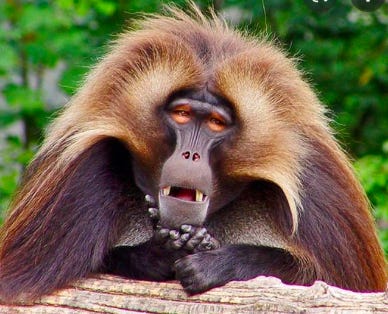
Stress, Baboons and the British Civil Service
I never fully appreciated the impact of stress on health until I realised that baboons don’t drink or smoke
We all keep being told that stress is bad but we do not really take the fact on board. On my journey of discovery I have read quite a lot about stress but the message never really sank in until I found a National Geographic/Stanford University documentary on the work of Stanford University, Neurobiologist Robert Sapolsky and also of Sir Michael Marmot Professor of Epidemiology and Public Health at University College London. (1)
These two individuals were carrying out similar studies in totally different parts of the world. Sapolsky was carrying out a study on the effect of social stress on baboons in Africa. Professor Marmot meanwhile was looking at the social stress of British civil servants.
It transpires that baboons, apart from having to focus on eating for 3 hours a day in order to get their required calories, do not have to worry about anything very much. Not having much to do, however, is pretty bad news. The community of baboons that Sapolsky studied spent most of their spare time “bothering” each other. A lot of tortuous, bullying behaviour took place and depending on where the baboons were in the social pecking order, resulted in different levels stress being experienced.
Needless to say the alpha males at the top of the pecking order were doing a lot of the bullying but not receiving anything back. They were in control of their situation and experienced no stress. The baboons lower down the pecking order never knew what to expect next …. From being pounced on, to having their hair pulled to worse – they were constantly in a heightened state of awareness and felt little control over their own situation.
Related studies in monkeys (by Carol Shively) found something really quite shocking. He carried out tests on his community of baboons and looked closely at the state of their arteries. The relationship between position in the hierarchy and narrowing of the arteries due to atherosclerosis was consistent. Those in the top echelons were fit and well and had clear, healthy arteries. As you moved down the social scale the level of “clogging” of the arteries increased and in addition weight also became an issue.
Even more concerning was that when they did comparative studies of the primates’ brains, further data came out to support the social strata theory. Brain atrophy (shrinkage) was also apparent leading to reduction in the cognitive behaviour of those primates lower down the social ladder.
The beauty of the study on baboons was that it was able to remove certain factors that might muddy the waters when looking at effects of stress on the human body. Baboons do not drink alcohol, they do not smoke and they all eat, pretty much, the same diet.
What British Civil Servants and Baboons Have in Common
Professor Marmot’s study that had spanned 40 years, looking at 28,000 British civil servants came to similar conclusions.
The British civil service has a very rigid hierarchical employment ranking system. Again, like in the baboon community the civil servants at the top felt much more in control over their existence than those at the bottom. Being able to observe so many people over such a time period, individuals who would have similar health care benefits and education, was very valuable. Marmot observed that ranking “intimately related to risk of disease and length of life”.
Bad Food Choices Heighten Anxiety
Whatever your view is on this research the main thing to take away is that stress …. is really bad and should be managed as much as possible. The perceived and unperceived physiological impact it has on our body cannot be underestimated. Stress will make you want to eat, hungry or not. Eating the wrong foods will only heighten anxiety and make the situation worse, whilst the right foods will minimise negative feelings.
Keto Calm – It’s a Thing
Always remember exercise is a good stress reliever and focusing on burning fat to produce ketones to fuel our body enhances a feeling of calm. Junk food will only increase anxiety and feelings of anger.
Marina Young, Hampshire, England
Poll
References
Stress, Portrait of a Killer - Full Documentary (2008) – YouTube
The Stress and Health Study – Whitehall II Sir Michael Marmot Professor of Epidemiology and Public Health