Tell Tale Signs of Insulin Resistance and a Bold Proposal for Cancer Charities
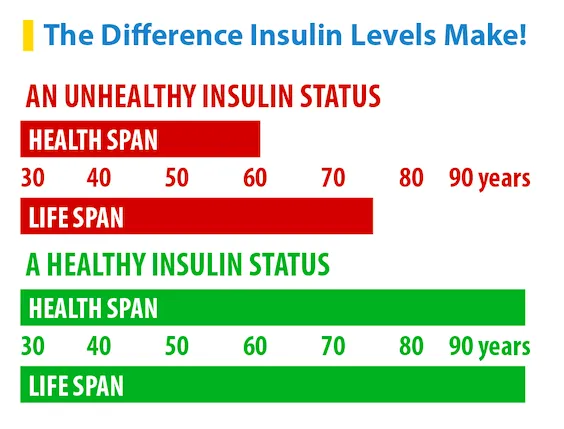
Your lifespan will likely be determined by the proportion of fat versus sugar you burn over your lifetime. Monitor your health span with the clues your body gives you.
One of the principal blood tests we take when we go to see the doctor for a health check is our blood sugar levels. The likelihood is that the doctor will give us the medical thumbs up as our results will show that our blood sugar levels are fine. Yet behind the scenes and unbeknownst to, still too many, doctors, our body is producing excessive amounts of insulin to keep our blood sugars healthy and in check.
In a Nutshell
(Even if you know this: I present you a simple way to explain it to loved ones who don’t)
Fortunately, more and more people are understanding that regularly consuming sugars, grains, starchy foods and beverages increases our production of insulin. The trouble is that overconsumption has meant that where eating a biscuit or even a bowl of porridge when we were young would have only caused our body to secrete a small quantity of insulin, we become desensitised overtime to its effect. That same biscuit or bowl of porridge, when consumed a few years later is likely to stimulate the secretion of a much, much larger quantity of insulin to deal with even a small amount of sugar in those same foods.
Over-production of insulin leads to resistance to insulin.
Resistance to insulin requires the body to produce more insulin … for insulin must do its job.
Over-production of insulin is known as hyperinsulinemia.
More insulin, more resistance, more resistance, more insulin and so on ….
Why does this matter?
At the Heart of Disease
Our over-production of insulin is at the heart of modern inflammatory diseases, obesity and a major driver of cancers. Yet because our insulin levels are never measured, we are given the thumbs up by our doctors. Yet we could be rapidly approaching a stroke or heart attack or quietly driving cancer whilst still producing healthy blood sugar test results!
The Signs Our Body Gives Us That Insulin Resistance is Becoming a Problem
Insulin’s nickname is the “Fat Storage Hormone”. When it circulates in our blood stream it not only stores all excess energy from the food we eat as fat, it also prevents our ability to access stored fat to burn for energy.
So, signs of insulin resistance are:
A growing waistline.
Skin tags, excess skin growth, often around the eyes, under arm on the torso.
Darker lines of excess skin cell growth in the creases of the elbow, behind the knees or what looks like dirt lines around the back of the neck.
The Clincher on Cancer
Insulin makes things grow. Not just our waistline but cancers too. Insulin prevents cells using fat for energy and the clincher is that healthy cells can thrive on sugar and fat for energy, while many cancer cells rely heavily on glucose and glutamine, although some cancers can burn fat. If those suffering from cancer were to pursue a strict ketogenic diet thus severely limiting sugar, it would enable healthy cells to access energy from fat whilst starving cancer cells of their principal source of energy, sugar. This weakens the cancer cells making them even more vulnerable to additional assault through radiotherapy and other forms of treatment that target the cancer cells.
Note that PET scans used for checking for cancer involves giving a patient a small amount of radioactive glucose. Cancer cells show up brighter in the scan because they are more active and take up more glucose than healthy cells do. (1)
A Back to Front World
It is frustrating to see major cancer charities using cake baking and coffee mornings in their campaigns to raise money for cancer research. On the subject of cancer charities, if we acknowledge that food plays a major role in cancer prevention and cancer treatment, we must realise that treatment through diet is a lot less lucrative than treatment through medical procedure and medication. Thus research tends to focus predominantly on treatments that involve pharmaceuticals and profit. Our lovely pharmaceutical companies make plenty of profit to reinvest into their own research. Perhaps cancer charities should divert their fundraising money towards research that focuses on treatments that involve diet and treatments with little financial profit to others. What do you say?
Salt Takes a Hit in the “War Against the War” on Sugar
In further examples of our back to front world, the “war against the war” on sugar, by those who are invested, has encouraged us to focus and demonise salt in our food instead. Challenges to our understanding and recommendations on salt intake will be for another article but for a final point in this article let us take a quick moment to acknowledge a 2011 study published in Metabolism that discovered that low salt diets increased insulin resistance in healthy subjects (link to full paper below). (2)
Marina Young, Hampshire, England
References
(1) Definition of radioactive glucose - NCI Dictionary of Cancer Terms
(2) Low-salt (LS) diet activates the renin-angiotensin-aldosterone and sympathetic nervous systems, both of which can increase insulin resistance (IR). https://pubmed.ncbi.nlm.nih.gov/21036373/